
Roofing in Van Nuys, CA: heat, winter rain, Santa Ana wind
Roofing in Van Nuys starts with the roof that is already there: postwar tract homes, 1960s–1970s apartment buildings and commercial corridors, all on the same valley floor. BFiber Roofing Repair & Install, based at 14202 Hamlin St, Van Nuys, CA 91401, discusses inspection findings and scope in writing before work starts. Call (818) 474-8963.
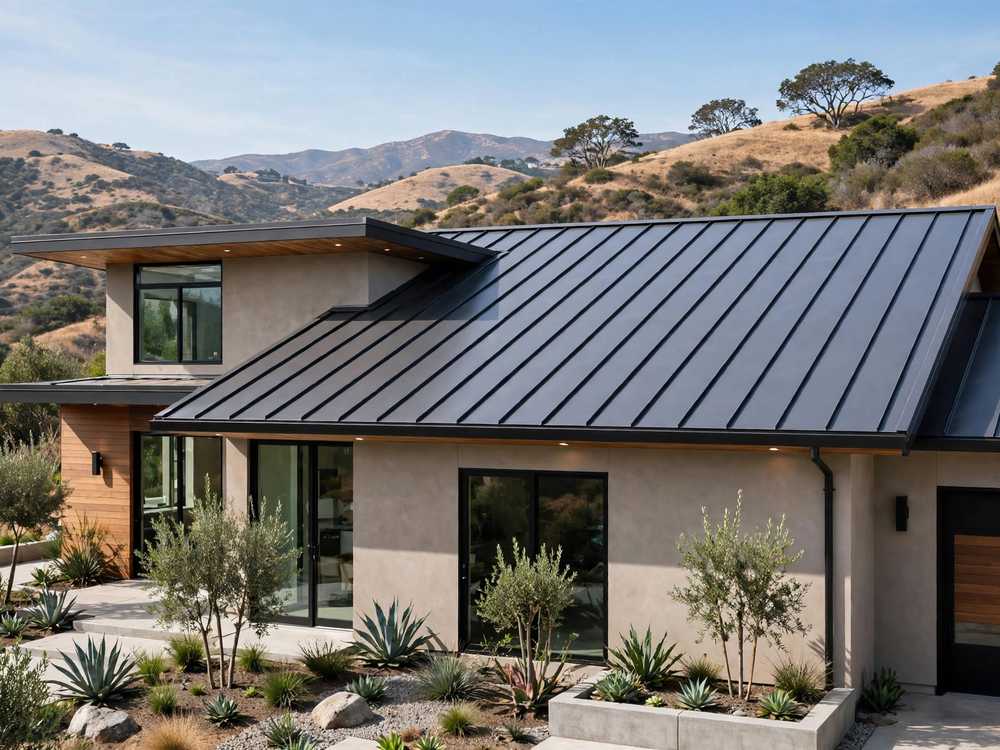
A postwar re-roof market, not a new-build market
Van Nuys is an ageing postwar re-roof market: the median year built is 1968 on an ACS basis, with 67.2% of homes built before 1980. The defining cohort is 1940s–1960s tract housing, plus a 1960s–1970s apartment boom whose flat roofs are a separate market.
Van Nuys was founded 22 February 1911, named for Isaac Newton Van Nuys, and annexed to the City of Los Angeles on 22 May 1915. That history is why permits here run through LADBS, not the County — and why a roofer who treats Van Nuys like an incorporated city will get the jurisdiction wrong.
The work that follows from that stock is specific. Tract houses need shingle re-roofs and tile underlayment renewal where the tile itself is still sound. Apartment and commercial buildings need flat-roof drainage, parapet flashing and membrane choice. Corridor storefronts need phased work that does not close the building underneath.
Valley heat is the main ageing driver: at Van Nuys Airport (NOAA 1991–2020) the July mean daily maximum is 91.2°F and August is 93.1°F. Annual rainfall is 13.42 inches, concentrated in winter, and Santa Ana winds run October to April. A single wet winter can produce a year's worth of leak demand: the 2023–2024 season recorded 29.76 inches at Van Nuys Airport against 6.05 inches in 2024–2025. The dated benchmark to remember is 4 February 2024, when 4.30 inches fell in one day.
Roofing services in Van Nuys
All 30 services below, from a single repair to a full replacement, each described for the Van Nuys roof it actually serves.
Roof Installation
New roof installation for postwar tract homes and for flat-roofed apartment and commercial buildings, with the system matched to roof pitch, deck and drainage.
Roof Replacement
Full tear-off and replacement when repair no longer makes sense — the core job in a postwar market where shingle and tile-underlayment cohorts are reaching end of life.
Roof Repair
Targeted repairs for leaks, missing shingles, flashing failure and granule loss on ageing tract roofs.
Roof Inspection
A walk-through inspection before purchase, before the rainy season, or after a storm, checking the field, flashing, valleys, penetrations and attic signs.
Roof Maintenance
Seasonal maintenance that keeps small problems small: debris, flashing and sealant checks, ridge-vent checks and exposed-fastener checks.
Residential Roofing
Roofing for single-family tract homes, duplexes and small multi-family buildings across Van Nuys.
Commercial Roofing
Roofing for corridor storefronts, apartments above retail and industrial-fringe buildings, phased so operations are not needlessly disrupted.
Flat Roofing
Low-slope roofing for apartments and commercial buildings: drainage and ponding, parapet flashing, and membrane selection by system, not by generic label.
Shingle Roofing
Asphalt composition shingle — the Valley tract-house workhorse — where heat-ageing, granule loss and curling are the Van Nuys story.
Tile Roofing
Tile work sold honestly: where tile itself is sound, the job is usually underlayment ageing and lift-and-relay, not tile breakage alone.
Metal Roofing
A long-life, modern-system niche in Van Nuys, not a mainstream tract choice; discussed on its merits, including cost and detailing.
TPO Roofing
TPO as one flat-roof membrane option, compared with EPDM and modified bitumen on drainage, seams and exposure.
EPDM Roofing
EPDM as one flat-roof membrane option for low-slope roofs, with seam and drainage detailing that decides whether it lasts.
Modified Bitumen Roofing
Torch-down / modified bitumen as one flat-roof system option, addressed alongside TPO and built-up roofing rather than as a competing generic page.
Roof Leak Repair
Leak tracing for winter-rain leaks: the stain rarely sits directly below the entry point, so valleys, flashing and penetrations are checked first.
Storm Damage Roof Repair
Post-storm triage after atmospheric rivers and Santa Ana wind: lifted shingles, ridge and cap damage, debris and flashing failures.
Emergency Roof Repair
Make-safe work after storm damage or an active leak: stop the water getting in, document what is found, and agree the permanent repair in writing.
Roof Tune-Up
A tune-up pass over flashing, sealant, fasteners and vents for roofs that do not yet need replacement.
Roof Cleaning
Roof cleaning that respects the material underneath: debris and growth removed without damaging shingles, tile or membrane.
Gutter Installation
Gutters as part of the roofing and drainage system, sized and detailed for concentrated winter rain, not as a standalone add-on.
Gutter Repair
Gutter repair where overflow, sagging or failed joints are letting water back onto fascia, walls or the roof edge.
Gutter Cleaning
Gutter cleaning as roofing-adjacent drainage work, including valley and downspout blockages that show up as roof leaks.
Downspout Installation
Downspouts that carry concentrated winter rain away from the roof edge, walls and foundations.
Fascia Repair
Fascia repair where gutter loads, overflow or rot have damaged the board behind the gutter line.
Soffit Repair
Soffit repair and vent checks, because intake ventilation and a sound eave edge matter to how a roof ages in Valley heat.
Skylight Installation
Skylight installation with flashing as the critical detail: a skylight is a roof penetration first and a window second.
Skylight Repair
Skylight leak tracing and reflashing, where the failure is usually the flashing detail rather than the glass.
Roof Ventilation Installation
Ventilation work that balances intake and exhaust so attic heat does not prematurely age the roof above it.
Attic Insulation
Attic insulation discussed alongside ventilation and roof condition, since heat, moisture and roof life are connected.
Roof Coating
Roof coating for suitable flat and low-slope roofs, with suitability and preparation stated honestly rather than promised for every roof.
Who this work is for
Homeowners in postwar tracts whose shingle or tile-underlayment roof is ageing out. Landlords and property managers with corridor apartment buildings whose flat roofs pond, blister or leak at seams. Small businesses and commercial owners along Van Nuys Boulevard, Sherman Way, Victory Boulevard, Burbank Boulevard, Oxnard Street and Sepulveda Boulevard, where a re-roof has to be phased around tenants and operations.
If you are in an HOA, get the HOA's roofing and material approval in writing before ordering — it is separate from the LADBS permit. If your home is in the Van Nuys HPOZ, ask the Office of Historic Resources about review before ordering, and do not assume a tax reduction under the Mills Act.
How a job is discussed, step by step
First, the roof is walked and what is found is documented, including valleys, flashing, penetrations, ridge and cap, and — where there is a leak — the attic signs below it. Second, the scope is put in writing: the system, the materials, the work, and the price for your roof. Third, the permit question is answered for your scope: A permit is required — confirm the repair-vs-re-roof line with LADBS for your scope. Van Nuys is in the City of Los Angeles, so permits run through LADBS, not the County.
Fourth, the work itself is the system in the right order — deck, underlayment, flashing, ventilation and finish layer — with the deck checked once the old material is off. Finally, the repair or replacement is walked again and the site is cleaned.
Roof problems Van Nuys roofs actually get
Active leaks after concentrated winter rain, where the stain is rarely directly below the entry point. Wind-lifted shingles and ridge or cap damage after Santa Ana events, which run October to April with Valley gusts of 50–65 mph in strong events. Ponding water on flat roofs, where drainage, slope and parapet flashing decide the outcome. Gutter overflow where debris and valley loads send water back onto fascia and walls. Attic heat, where ventilation balance decides how fast the roof above ages.
For each problem, start with the matching service page: roof leak repair, shingle roofing, flat roofing, gutter repair and roof ventilation installation.
Talk through your roof before work starts
No customer reviews are published on this page. Call (818) 474-8963 to describe the leak, the stain, the missing shingles or the flat-roof ponding you are seeing, and discuss the written scope for your roof. BFiber is based at 14202 Hamlin St, Van Nuys, CA 91401.
Roofing areas around Van Nuys
Van Nuys proper first — its civic precinct, airport precinct, pockets, corridors and Sepulveda Basin fringe — then the separate neighbouring communities. Corridors and pockets are labelled as corridors and pockets, never upgraded to neighbourhoods.
Van Nuys: The main Van Nuys page: postwar tracts, corridor apartments and commercial roofs in the City of Los Angeles neighbourhood, annexed 22 May 1915.
Van Nuys Civic Center area: A civic precinct, not a residential neighbourhood: large low-slope commercial and government-adjacent roofs, with historic-review caution near the 1932 City Hall.
Van Nuys Airport area: An airfield and industrial precinct, not a residential neighbourhood: hangar, warehouse and industrial low-slope and metal systems.
Sepulveda Basin fringe: A fringe adjacency only, not a neighbourhood: the Basin is a flood-control basin and recreation area, and basin parkland that is designed to flood must not be confused with a home's flood zone.
Delano Park area: A park-anchored residential pocket: postwar tract housing around the park, with shingle and tile re-roofs and park-tree debris in gutters and valleys.
Van Nuys Recreation Center pocket: A park-anchored residential pocket at Vanowen–Tyrone: postwar tract character with a recreation-center anchor.
Van Nuys Boulevard corridor: A north–south commercial spine, not a neighbourhood: mixed commercial storefronts, apartments above retail, and corridor commercial roofs.
Sherman Way corridor: An east–west corridor through northern and central Van Nuys: commercial, apartment and tract mix, with corridor apartment flat roofs.
Victory Boulevard corridor: An east–west corridor through central and southern Van Nuys: commercial, apartment and tract mix.
Burbank Boulevard corridor: An east–west southern-edge corridor: edge position means the Sherman Oaks boundary must be handled explicitly.
Oxnard Street corridor: An east–west southern-boundary corridor in the broad definition: southern-belt housing and commercial roofs.
Sepulveda Boulevard corridor: A north–south corridor in west Van Nuys, at the airport and basin edge: industrial, commercial and residential fringe.
Kester Avenue area: A street-anchored residential pocket, not a formal neighbourhood: central tract shingle cohorts and corridor apartment buildings.
Hazeltine Avenue area: A street-anchored residential pocket and eastern boundary street, not a formal neighbourhood: eastern-edge tract roofs and Wash-adjacent drainage.
Roscoe–Saticoy pocket: A north Van Nuys industrial-residential fringe pocket around the former GM plant area.
Woodman Avenue area: An eastern boundary pocket at the Tujunga Wash edge: Wash-adjacent drainage and gutter capacity matter here.
Lake Balboa: A separate neighbouring community, not part of Van Nuys: renamed from a larger portion of Van Nuys on 2 November 2007.
Valley Glen: A separate neighbouring community, not part of Van Nuys: it became official in June 1998.
Sherman Oaks: A separate neighbouring community to the south, sharing the 91411 ZIP footprint in part and the southern boundary corridors.
Panorama City: A separate neighbouring community to the north-east of Van Nuys.
North Hills: A separate neighbouring community, formerly called Sepulveda; the name Sepulveda also refers to a boulevard and a basin, three different things.
Van Nuys and its precincts, pockets, corridors and fringe
- Van Nuys
- Van Nuys Civic Center area
- Van Nuys Airport area
- Sepulveda Basin fringe
- Delano Park area
- Van Nuys Recreation Center pocket
- Van Nuys Boulevard corridor
- Sherman Way corridor
- Victory Boulevard corridor
- Burbank Boulevard corridor
- Oxnard Street corridor
- Sepulveda Boulevard corridor
- Kester Avenue area
- Hazeltine Avenue area
- Roscoe–Saticoy pocket
- Woodman Avenue area
Neighbouring communities served
A note on Van Nuys boundaries and ZIP codes
Van Nuys has two boundary systems that do not coincide: a broad LA Times / Mapping L.A. boundary and a narrower Van Nuys Neighborhood Council boundary. This site does not draw a boundary map from either, and it does not treat a ZIP code as a neighbourhood. The ZIP codes 91401, 91405, 91406 and 91411 are all used in Van Nuys, but none maps cleanly onto Van Nuys proper: 91406 is shared with Lake Balboa, 91411 is heavily shared with Sherman Oaks, and 91409 is a PO-Box ZIP only, not a residential service area.
That is also why this site has no page for Lake Balboa, Valley Glen or Magnolia Woods as part of Van Nuys, no ‘West Van Nuys’, ‘North Van Nuys’ or ‘Downtown Van Nuys’ district page, and no page for Sepulveda Basin as a neighbourhood. Lake Balboa and Valley Glen were formerly part of the larger Van Nuys footprint and are now separate communities; Magnolia Woods was redesignated to Sherman Oaks in 1991.
Roofing in Van Nuys: common questions
Straight answers, with sources and limits stated where they matter. If your question is not here, call (818) 474-8963.
Ask any roofer for licence, insurance and permit paperwork, and for a written scope that names the materials, the work and the price before work starts. C-39 is the licence class and scope for roofing work in California; it is not, by itself, proof about a particular firm. BFiber discusses scope in writing before work, and customers should ask any roofer — including BFiber — for its licence and insurance paperwork.
Published market data, not this firm's prices: Los Angeles roof replacement averaged $17,271, ranging $10,256–$24,963 (Angi, updated 31 July 2026); California roof repair ranged $450–$3,200 (Modernize, updated 26 August 2026); Los Angeles flat-roof replacement was $7–$15 per square foot (Angi, 31 July 2026). Your own roof needs a written scope after an inspection: size, pitch, deck condition, material and permit route all change the figure. No price on this page is a BFiber price, and no other price promise is made here.
A permit is required — confirm the repair-vs-re-roof line with LADBS for your scope. Van Nuys is in the City of Los Angeles, so permits run through LADBS, not the County. The 2025 California Building Standards Code (Title 24) is effective 1 January 2026, and Los Angeles adopted it via Ordinance No. 188797, effective the same date. A full roof replacement in the City of Los Angeles requires an LADBS permit, and the permit fee is confirmed with LADBS for each job.
Valley heat is the main ageing driver: at Van Nuys Airport (NOAA 1991–2020) the July mean daily maximum is 91.2°F and August is 93.1°F. Annual rainfall is 13.42 inches, concentrated in winter, and Santa Ana winds run October to April. Van Nuys is an ageing postwar re-roof market: the median year built is 1968 on an ACS basis, with 67.2% of homes built before 1980. The defining cohort is 1940s–1960s tract housing, plus a 1960s–1970s apartment boom whose flat roofs are a separate market. Demand here is heat, concentrated winter rain and Santa Ana wind — not snow, and not community-level fire-hardening: Van Nuys is flat valley floor and is absent from LAFD's Very High Fire Hazard Severity Zone community list, though parcel status must still be checked per address.
Cool-roof rules depend on the parcel's Title 24 climate zone, so check the zone for your address rather than assuming one; the sourced Valley figures are Climate Zone 9. The Van Nuys HPOZ was adopted 16 November 2005, but no boundary map is published here because City documents summarise its western edge differently. If your home is in the HPOZ, ask the Office of Historic Resources about review before ordering.
Need roofing in Van Nuys?
Call (818) 474-8963 and describe what you are seeing. Scope is discussed in writing before work starts.
Contact BFiber Roofing Repair & Install
Phone is the contact channel for this firm. Call (818) 474-8963 to describe what you are seeing on your roof and to discuss scope in writing before any work starts.
- Phone
(818) 474-8963 - Address
14202 Hamlin St, Van Nuys, CA 91401, United States
Open in Google Maps · 14202 Hamlin St, Van Nuys, CA 91401